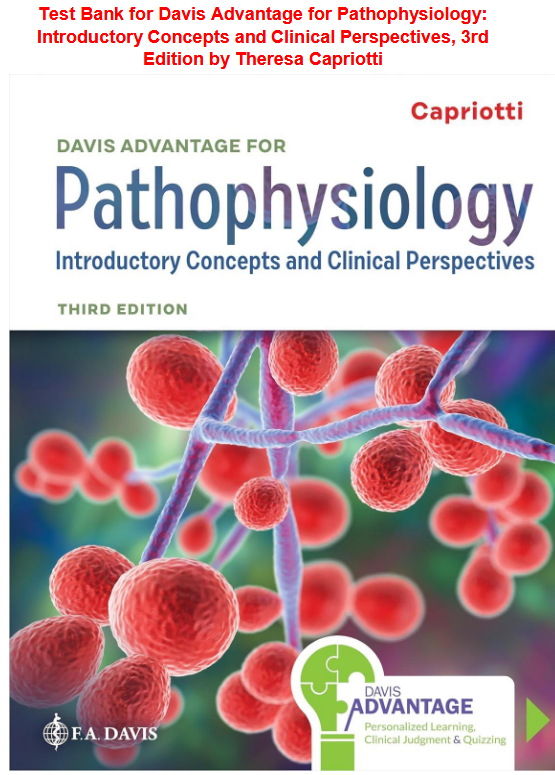
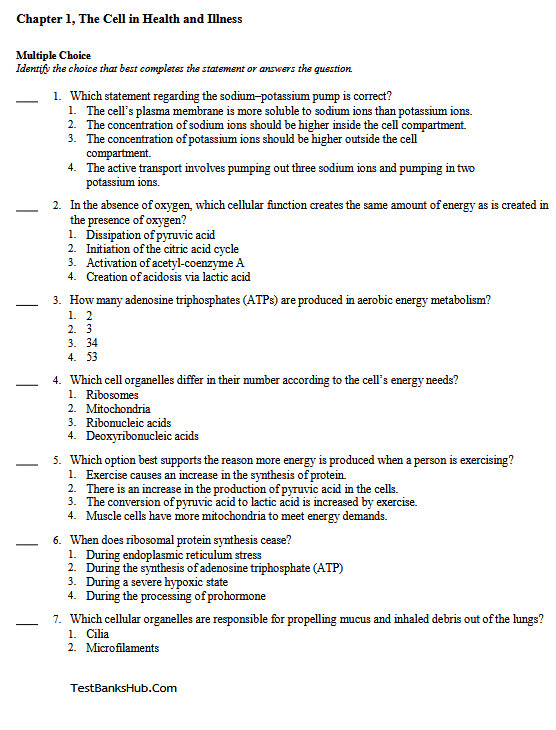

This comprehensive test bank is the essential assessment and study resource for Davis Advantage for Pathophysiology: Introductory Concepts and Clinical Perspectives, 3rd Edition by Theresa Capriotti. It offers a vast collection of high-quality questions mapped directly to the textbook’s content, designed to rigorously test student comprehension, assess critical thinking, and build a strong foundation for clinical practice.
Why This Test Bank is Essential
Pathophysiology is the bridge between basic science and clinical medicine. A deep understanding of disease mechanisms is fundamental to nursing and other healthcare professions. This test bank ensures students master the core concepts by focusing on application, analysis, and clinical correlation.
1. Focus on Clinical Relevance (Introductory Concepts & Clinical Perspectives):
-
Bridging Theory and Practice: Questions frequently link the underlying biological processes (the pathos) to the clinical manifestations and treatments (the clinical perspectives), forcing students to integrate concepts just as they must in patient care.
-
Case-Based Learning: The bank includes scenarios that require students to apply knowledge of cellular injury, inflammation, and organ system dysfunction to realistic patient situations.
2. Comprehensive and Detailed Content Coverage:
The test bank thoroughly covers every chapter and key concept found in the 3rd Edition textbook, including:
-
Foundational Processes: Cellular function, genetics, fluid and electrolytes, acid-base balance, inflammation, infection, and immunological disorders.
-
Systemic Pathophysiology: Detailed coverage of disease processes affecting all major organ systems (e.g., cardiovascular, respiratory, gastrointestinal, renal, neurological, endocrine, integumentary).
-
Special Topics: Questions on pain, stress, cancer, and environmental health issues.
3. Superior Learning and Assessment Features:
-
NCLEX-Style Questions: The collection features a significant number of multiple-choice, Select-All-That-Apply (SATA), and critical thinking questions designed to mirror the format and rigor of professional licensing exams.
-
Analytical Depth: Questions emphasize analysis, synthesis, and evaluation, moving beyond simple factual recall to assess true mastery of disease mechanisms and progression.
-
Detailed Rationales: Each question is accompanied by a comprehensive, educational rationale explaining why the correct answer is best and detailing why the incorrect options are insufficient. This turns every test attempt into an effective study session.
🔬 Mastering the Mechanisms of Disease
The Test Bank for Capriotti’s 3rd Edition is the most effective tool available for students aiming to solidify their understanding of pathophysiology. By systematically engaging with these practice questions, students will:
-
Systematically Identify Knowledge Gaps: The rationales immediately highlight areas where the underlying biological or physiological basis of disease is not fully grasped, enabling highly focused and efficient review.
-
Enhance Critical Thinking: Pathophysiology often involves understanding complex chains of events (e.g., how chronic hypertension leads to heart failure). The multi-step questions train the user to trace these processes accurately.
-
Prepare for Advanced Courses: A strong foundation in pathophysiology is prerequisite for pharmacology, medical-surgical nursing, and specialized clinical courses. Mastery of this test bank ensures readiness for more advanced academic challenges.
-
Connect Pathology to Treatment: Many questions require the user to understand why a specific drug or intervention is used based on the underlying pathophysiology (e.g., why ACE inhibitors are effective in heart failure).
💡 Detailed Content Breakdown
The test bank is logically organized to align with the textbook structure, facilitating integrated learning:
-
Module I: Cellular and General Concepts: Questions on basic cellular adaptation and injury, the mechanisms of fever, the inflammatory response cycle, and the immune system’s role in health and disease.
-
Module II: Fluid, Electrolyte, and Acid-Base Balance: Extensive coverage of imbalances (e.g., hyper/hyponatremia, metabolic vs. respiratory acidosis/alkalosis) and the compensatory mechanisms of the body.
-
Module III: System-Specific Pathophysiology: This crucial section offers hundreds of application and analysis questions covering the etiology, risk factors, clinical manifestations, and complications of major diseases, including:
-
Cardiovascular: Atherosclerosis development, different types of shock, and the mechanisms of myocardial infarction.
-
Respiratory: V/Q mismatch, restrictive vs. obstructive diseases (e.g., COPD, Asthma), and acute respiratory distress syndrome (ARDS).
-
Renal: Glomerular filtration rate (GFR) regulation, acute kidney injury (AKI), and chronic kidney disease (CKD) progression.
-
Endocrine: The pathogenesis of Type 1 and Type 2 diabetes mellitus, thyroid disorders, and adrenal dysfunction.
-
🖥️ Usability for Faculty and Learning Management
This resource is primarily intended for faculty use to create customized, high-stakes assessments, ensuring validity and alignment with course objectives.
-
LMS Compatibility: The files are typically structured for easy import and integration into major Learning Management Systems (LMS) such as Blackboard, Canvas, Moodle, and ExamView.
-
Metadata Tagging: Every question is meticulously categorized with essential data for efficient assessment creation:
-
Cognitive Level: (e.g., Comprehension, Application, Analysis)
-
Difficulty Level: (e.g., Easy, Moderate, Difficult)
-
Chapter/Section Reference: Allows for quick tracing back to the source text.
-
The Test Bank for Davis Advantage for Pathophysiology, 3rd Edition is more than just a testing tool; it’s a critical component of learning that promotes deep understanding and fosters the clinical judgment necessary for all healthcare professionals. It ensures that complex concepts are not just memorized, but truly understood and ready for application in clinical care.


Reviews
There are no reviews yet.