Understanding the human body is the foundation of everything in healthcare.
Before you can understand disease, you need to understand normal. Before you can recognize what’s wrong with a patient, you need to know exactly how the body works when everything is right. That’s what anatomy and physiology teaches — and that’s why it’s one of the most important courses in any pre-nursing or allied health program.
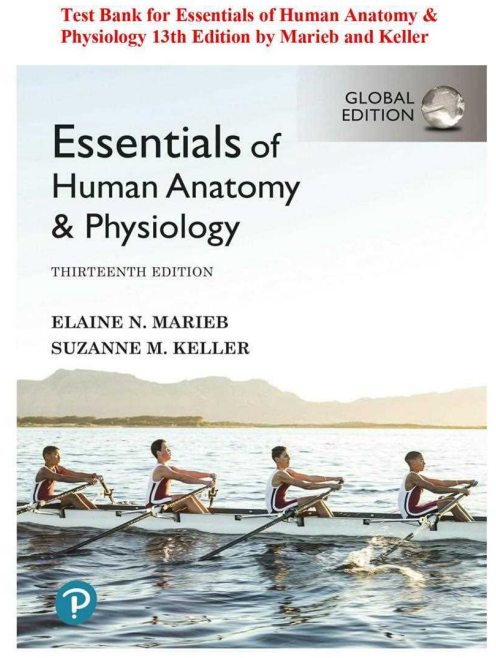
This test bank is built for the 13th Edition of Essentials of Human Anatomy & Physiology by Elaine Marieb and Suzanne Keller. It’s your chapter-by-chapter study companion for one of the most widely used A&P textbooks in nursing and allied health education.
Stop re-reading the same chapters hoping the content sticks. Start testing yourself — the way your professor will.
What’s Inside?
- Hundreds of practice questions covering every chapter
- Multiple-choice, true/false, matching, and short-answer style questions
- Complete answer keys with clear, detailed rationales
- Questions covering anatomical structures, physiological processes, and clinical applications
- Content aligned with nursing and allied health program exam standards
Who Is This Test Bank For?
This resource is perfect for:
- Pre-nursing students completing A&P prerequisites
- Allied health students in medical assisting, radiography, and respiratory therapy programs
- Nursing students reviewing foundational anatomy and physiology
- Science instructors building course exams and unit assessments
- Healthcare professionals refreshing their foundational science knowledge
Topics Covered Include:
- Organization of the human body and homeostasis
- Basic chemistry and cell biology
- Tissues and the integumentary system
- The skeletal system and bone physiology
- The muscular system and muscle mechanics
- The nervous system and special senses
- The endocrine system and hormonal regulation
- The cardiovascular system — heart and blood vessels
- The lymphatic system and body defenses
- The respiratory system and gas exchange
- The digestive system and nutrient metabolism
- The urinary system and fluid balance
- The reproductive system and human development
Why This Test Bank Works
Anatomy and physiology is a high-volume course. There’s simply no shortcut around learning the content — but there is a smarter way to study it.
Testing yourself repeatedly is one of the most proven study strategies in education. It forces active recall, identifies knowledge gaps, and builds the kind of long-term retention that re-reading alone never achieves. This test bank puts that strategy to work for every single chapter of Marieb and Keller’s textbook.
Every question is written to challenge your understanding — not just your ability to recognize a familiar phrase. You’ll work through questions on anatomical relationships, physiological mechanisms, and clinical relevance. That prepares you for both course exams and the science-heavy portions of the NCLEX.
Questions are organized chapter by chapter for structured, focused review. Detailed rationales explain the science behind every correct answer — so you’re learning while you practice.
Sample Questions
Question 1 Which of the following best describes the concept of homeostasis?
- A) The process by which cells divide and reproduce
- B) The body’s ability to maintain a stable internal environment despite external changes
- C) The movement of nutrients from the digestive system into the bloodstream
- D) The regulation of hormone levels by the pituitary gland only
Correct Answer: B Rationale: Homeostasis refers to the body’s dynamic ability to maintain a relatively stable internal environment — including temperature, pH, blood glucose, and fluid balance — despite constant changes in the external environment. It is a foundational concept in physiology that underlies all body system function. Options A, C, and D describe specific physiological processes, not the broader concept of homeostasis.
Question 2 A patient suffers a fracture to the diaphysis of the femur. Which part of the bone is affected?
- A) The rounded ends of the bone that form joints
- B) The shaft or long central portion of the bone
- C) The dense outer layer of compact bone tissue
- D) The inner spongy layer containing red bone marrow
Correct Answer: B Rationale: The diaphysis is the long central shaft of a long bone such as the femur. It is composed primarily of compact bone and surrounds the medullary cavity. The epiphyses are the rounded ends of long bones. Compact bone refers to the dense outer tissue layer, and spongy bone refers to the trabecular inner layer — neither is specifically called the diaphysis.
Question 3 Which of the following correctly describes the function of the myelin sheath in the nervous system?
- A) It produces neurotransmitters at the synaptic terminal
- B) It acts as a receptor for incoming sensory signals
- C) It insulates the axon and speeds up electrical signal transmission
- D) It connects two neurons across a synapse
Correct Answer: C Rationale: The myelin sheath is a fatty insulating layer that surrounds the axons of many neurons. It speeds up nerve impulse conduction through a process called saltatory conduction, where the electrical signal jumps between gaps in the myelin called nodes of Ranvier. Neurotransmitters are produced and released at synaptic terminals, not by the myelin sheath. The synapse itself — not the myelin — is the junction between two neurons.
Question 4 During vigorous exercise, a patient’s respiratory rate increases significantly. Which physiological principle best explains this response?
- A) Positive feedback mechanism restoring acid-base balance
- B) Negative feedback mechanism responding to rising carbon dioxide levels
- C) Hormonal regulation by the adrenal medulla
- D) Voluntary control of breathing initiated by the cerebral cortex
Correct Answer: B Rationale: During exercise, increased cellular metabolism produces more carbon dioxide, which lowers blood pH. Chemoreceptors detect this change and signal the respiratory center in the brainstem to increase breathing rate — expelling excess CO₂ and restoring pH balance. This is a classic negative feedback mechanism. While adrenaline and voluntary breathing do play roles during exercise, the primary driver of increased respiratory rate is the negative feedback response to rising CO₂ levels.
Question 5 Which of the following organs is both an endocrine and exocrine gland?
- A) Thyroid gland
- B) Adrenal gland
- C) Pancreas
- D) Pineal gland
Correct Answer: C Rationale: The pancreas functions as both an endocrine gland — secreting insulin and glucagon directly into the bloodstream to regulate blood glucose — and an exocrine gland — releasing digestive enzymes through ducts into the small intestine. The thyroid, adrenal, and pineal glands are purely endocrine, secreting hormones directly into the blood without ductal systems.
Frequently Asked Questions (FAQs)
What edition does this test bank cover? This test bank is written specifically for the 13th Edition of Essentials of Human Anatomy & Physiology by Marieb and Keller. All questions are fully aligned with the current edition’s chapter organization and updated content.
How are the questions organized? Questions are arranged chapter by chapter, allowing you to study systematically or focus on specific body systems where you need the most practice. Every question comes with a correct answer and a detailed rationale.
Is this test bank useful for NCLEX preparation? Yes. A strong foundation in anatomy and physiology directly supports NCLEX success. Many NCLEX questions require understanding of normal body function before you can apply clinical reasoning to disease and nursing interventions. This test bank strengthens that foundation.
Is this suitable for non-nursing students? Absolutely. This test bank is valuable for any allied health student — including those studying medical assisting, radiography, physical therapy assisting, respiratory therapy, and more. If your program uses Marieb and Keller’s textbook, this test bank is built for you.
How soon can I access the test bank after purchase? Immediately. After completing your purchase, you receive instant digital access with no waiting period. Study on your schedule, at your pace.
Are the rationales helpful for actual learning — not just test prep? Yes. The rationales are written to explain the underlying science behind each answer. This means you’re building genuine comprehension — not just pattern-matching to exam questions. That kind of deep understanding is what carries you through both exams and clinical practice.
Does this test bank reflect the most current content in the 13th Edition? Yes. The questions are aligned with the updated content, terminology, and chapter structure of the 13th Edition — so your study prep stays current and relevant.


Gerald N –
This is exactly what I needed to get ready for my finals
Lucille Maria –
An excellent study resource