
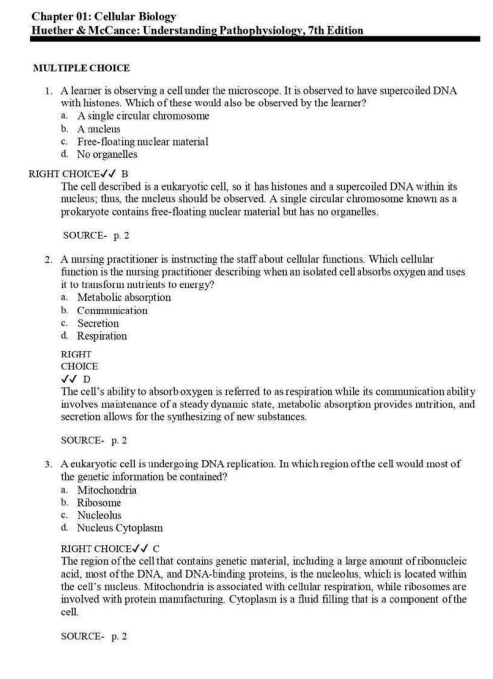
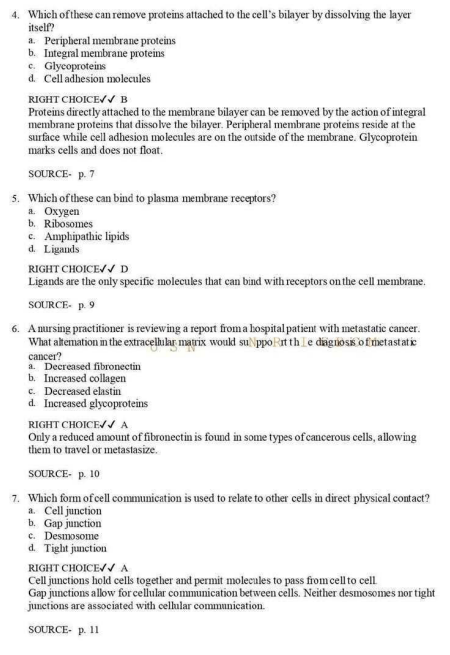
Pathophysiology can feel like drinking from a fire hose. There’s so much happening at once: cells, hormones, immune responses, organ systems, all interacting in ways that aren’t always easy to picture. Understanding Pathophysiology, 7th Edition by Huether, McCance, and Brashers is known for breaking that complexity down clearly, which is exactly why it’s used in so many nursing and health science programs.
This test bank was built to match that same clarity. It’s not a pile of surface-level questions. It’s written to test whether you actually understand disease mechanisms, not just whether you memorized a term. You get realistic questions, correct answers, and rationales that explain the reasoning step by step.
If pathophysiology has ever left you feeling like the pieces don’t connect, this kind of focused practice helps put them together.
What Is a Test Bank?
A test bank is a large set of practice questions built around a specific textbook. The questions are based on the same chapters, mechanisms, and case examples covered in the book. Instructors often use test banks like this one to help build their exams, so practicing with it gives you a real sense of what your test might actually include.
It’s not a way to skip the studying. It’s a way to study smarter, with material that matches your course.
Why Students Use This Test Bank
Pathophysiology courses build on themselves fast. If you don’t fully get one system, the next one gets harder to follow. This test bank helps you catch gaps early, before they turn into bigger problems at exam time.
Here’s what you get:
- Full coverage of major topics from the 7th edition
- Multiple choice and scenario-based questions
- Complete answer keys
- Rationales that explain the correct and incorrect choices
- Questions written to test understanding, not just recall
Instead of rereading the same chapter five times hoping something sticks, you get active practice that shows you exactly where you stand.
Topics Covered
This test bank follows the structure of the textbook and covers key areas, including:
- Cellular biology and cellular injury
- Genetics and genetic disorders
- Immunity and inflammation
- Infection and infectious disease
- Fluid, electrolyte, and acid-base balance
- Neoplasia and cancer biology
- Stress and disease
- The nervous system
- The cardiovascular system
- The respiratory system
- The renal and urologic system
- The digestive system
- The endocrine system
- The musculoskeletal system
Every major system and disease mechanism from the book is represented, so you can study in the same structure your course follows.
Sample Questions from the Test Bank
Here are five sample questions so you can see the format and style. Each one includes the correct answer and a rationale.
Question 1
Which term describes a cell’s reversible response to a change in its environment, such as increased workload?
A. Necrosis
B. Apoptosis
C. Adaptation
D. Neoplasia
Correct Answer: C
Rationale: Adaptation refers to reversible changes a cell makes to survive a new demand or stress, such as increased size (hypertrophy) or number (hyperplasia). Necrosis and apoptosis both involve cell death, and neoplasia refers to abnormal, uncontrolled cell growth, not a normal adaptive response.
Question 2
A patient has a blood pH of 7.30 and an elevated carbon dioxide level. This is most consistent with which condition?
A. Respiratory alkalosis
B. Metabolic alkalosis
C. Respiratory acidosis
D. Metabolic acidosis
Correct Answer: C
Rationale: A low blood pH combined with elevated carbon dioxide points to respiratory acidosis, which happens when the lungs aren’t removing enough carbon dioxide from the body. Metabolic conditions involve changes in bicarbonate levels, not primarily carbon dioxide.
Question 3
Which type of immunity is provided by receiving antibodies from another source, such as through breast milk or an antibody injection?
A. Active natural immunity
B. Active artificial immunity
C. Passive natural immunity
D. Passive artificial immunity
Correct Answer: C
Rationale: Passive natural immunity happens when antibodies are transferred from one person to another, such as from a mother to an infant through breast milk. Passive artificial immunity would come from a source like an antibody injection instead. Active immunity requires the person’s own immune system to produce the antibodies.
Question 4
A patient with long-standing type 2 diabetes develops numbness and tingling in the feet. This complication is best explained by damage to which structures?
A. Skeletal muscles
B. Peripheral nerves
C. Sweat glands
D. Tendons
Correct Answer: B
Rationale: Long-term high blood sugar can damage peripheral nerves over time, leading to numbness, tingling, and reduced sensation, a condition known as diabetic peripheral neuropathy. Muscles, sweat glands, and tendons aren’t the primary structures affected in this complication.
Question 5
Which finding is a hallmark sign of left-sided heart failure?
A. Peripheral edema
B. Jugular vein distention
C. Pulmonary congestion
D. Ascites
Correct Answer: C
Rationale: Left-sided heart failure causes blood to back up into the lungs, leading to pulmonary congestion and symptoms like shortness of breath. Peripheral edema, jugular vein distention, and ascites are more closely associated with right-sided heart failure, where blood backs up into the systemic circulation instead.
Why This Test Bank Actually Helps You Learn
Pathophysiology isn’t really about memorizing symptoms. It’s about understanding cause and effect. Why does one problem in the body lead to another? What’s happening at the cellular or system level that explains what you’re seeing in a patient?
That’s why every rationale in this test bank explains the reasoning, not just the correct letter. Once you understand the “why,” it gets easier to connect ideas across body systems instead of studying them as separate, unrelated topics.
Who This Test Bank Is For
This resource works well for:
- Students currently using the 7th edition of Understanding Pathophysiology
- Nursing and health science students taking a pathophysiology course
- Students preparing for midterms, finals, or licensing exams
- Instructors building quizzes or practice exams
- Study groups reviewing disease mechanisms together
However you study best, through repetition, scenarios, or reasoning things out, this test bank fits into your routine.
How to Use This Test Bank Effectively
A few simple habits make a real difference:
- Study one body system or chapter at a time.
- Try to answer each question before checking the key.
- Read every rationale, even for the ones you get right.
- Revisit topics that gave you trouble a few days later.
- Use this alongside your textbook and lecture notes, not as a replacement for them.
Steady, spaced-out practice beats cramming the night before every time.
Instant Access, No Waiting
Once you complete your purchase, you get instant access to the full test bank. No shipping, no waiting around. You can start studying right away.
FAQs
Is this test bank the same as the textbook?
No. This is a supplemental study resource meant to be used alongside Understanding Pathophysiology, 7th Edition, not in place of it.
Does this cover all the body systems in the book?
Yes. The test bank follows the same chapter structure as the 7th edition, covering all major systems and disease processes.
Are answers and rationales included?
Yes. Every question comes with the correct answer and a clear explanation of the reasoning behind it.
Is this test bank useful for licensing exam prep?
Yes. The questions focus on understanding disease mechanisms and applying that knowledge, which lines up well with how licensing exam questions are written.
Will I get instant access after purchase?
Yes. Access is available right after checkout, with no physical shipping involved.
Can instructors use this too?
Yes. Instructors often use test banks like this one to build quizzes or extra practice material for students.
Is this a one-time purchase?
Yes. You pay once and get full access to the material.
What if I only need help with certain systems or chapters?
The test bank is organized by chapter, so you can go straight to the section you need.
Final Thoughts
Pathophysiology asks you to see the bigger picture behind every disease, not just memorize a list of symptoms. This test bank for Understanding Pathophysiology, 7th Edition is built to help you see that picture clearly. Real questions, honest rationales, and practice that builds true understanding.
Study with purpose. Walk into your exam ready to think it through.


Reviews
There are no reviews yet.