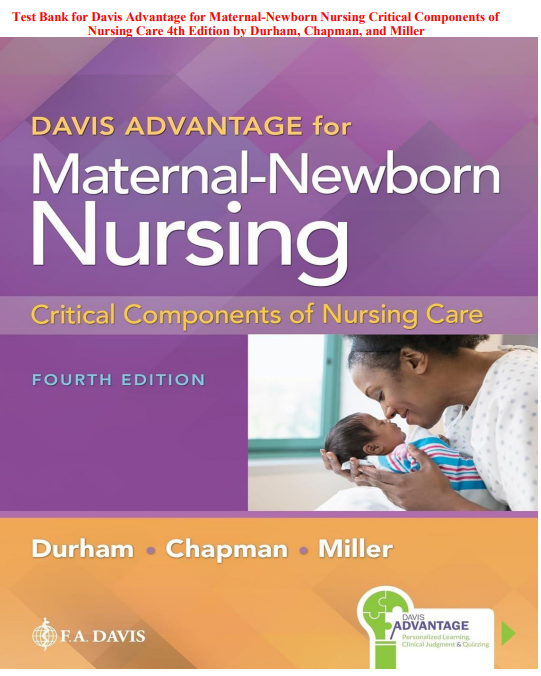
Maternal-newborn nursing asks you to think about two patients at once. The mother and the baby, both changing quickly, both needing close attention. Davis Advantage for Maternal-Newborn Nursing: Critical Components of Nursing Care, 4th Edition by Durham, Chapman, and Miller is built around exactly that kind of thinking, which is why so many nursing programs rely on it.
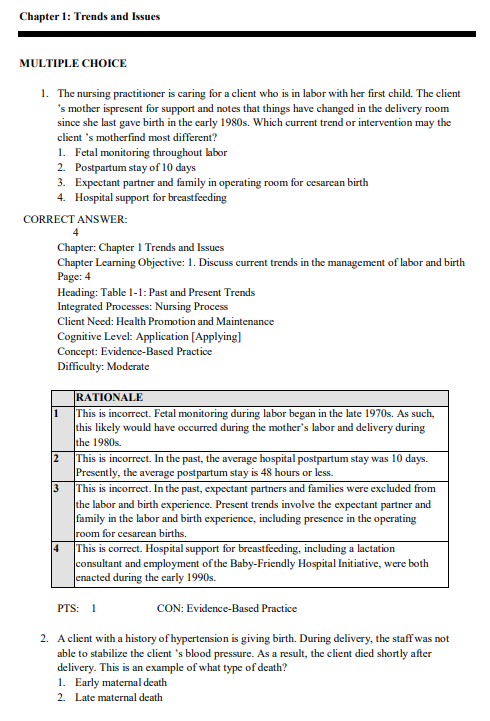
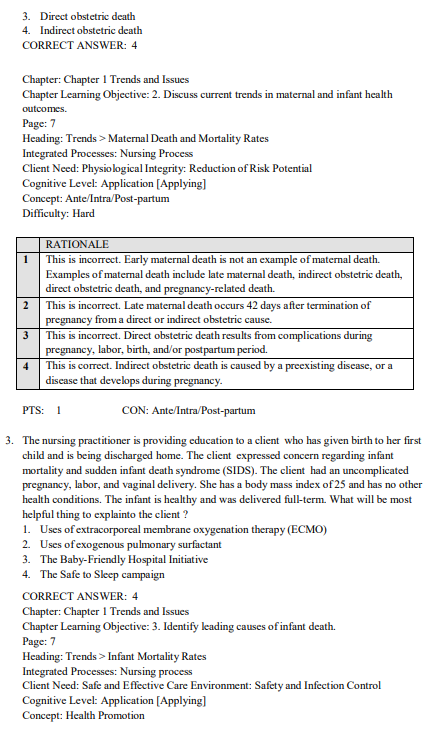
This test bank was built to match that focus. It’s not a set of surface-level questions. It’s written to test your ability to recognize what’s normal, what’s not, and what to do about it. You get realistic questions, correct answers, and rationales that walk you through the clinical reasoning behind each one.
If this course has ever felt like a lot to track at once, mother and baby, labor and recovery, this kind of focused practice helps it come together.
What Is a Test Bank?
A test bank is a large set of practice questions built around a specific textbook. The questions follow the same chapters, stages of care, and clinical scenarios covered in the book. Instructors often use test banks like this one to help build their exams, so practicing with it gives you a strong sense of what your exam might actually include.
It’s not a way to skip studying. It’s a way to study with material that matches your course.
Why Students Use This Test Bank
Maternal-newborn courses move through pregnancy, labor, birth, and the postpartum period fast, and each stage brings its own set of complications to know. This test bank helps you build a clear picture of what’s expected at each stage, so you’re not caught off guard on exam day.
Here’s what you get:
- Full coverage of major topics from the 4th edition
- Multiple choice and scenario-based questions
- Complete answer keys
- Rationales that explain the correct and incorrect choices
- Questions written the way real maternal-newborn exams are structured
Instead of trying to memorize every stage separately, you get organized practice that shows you how the pieces connect.
Topics Covered
This test bank follows the structure of the textbook and covers key areas, including:
- Prenatal care and fetal assessment
- Complications of pregnancy
- Labor and birth processes
- Fetal monitoring and intrapartum care
- Pain management during labor
- Postpartum physical recovery
- Postpartum complications and hemorrhage
- Newborn transition and assessment
- Newborn complications and high-risk conditions
- Breastfeeding and infant feeding
- Perinatal loss and grief
- Family adaptation to a new baby
- Cultural considerations in maternal-newborn care
Every major stage from the book is represented, so you can study in the same order your course follows.
Sample Questions from the Test Bank
Here are five sample questions so you can see the format and style. Each one includes the correct answer and a rationale.
Question 1
A laboring patient’s fetal heart rate tracing shows late decelerations that repeat with each contraction. What is the nurse’s priority action?
A. Continue monitoring without intervention
B. Reposition the patient onto her side and notify the provider
C. Encourage the patient to push harder
D. Increase the rate of oxytocin infusion
Correct Answer: B
Rationale: Late decelerations suggest reduced blood flow to the placenta, so repositioning the patient (usually to her left side) can improve blood flow, and the provider needs to be notified right away. Continuing without action ignores a warning sign, and increasing oxytocin would make the contractions stronger, which could worsen the problem.
Question 2
A postpartum patient’s uterus is soft and boggy on palpation, and she has heavy vaginal bleeding. What should the nurse do first?
A. Massage the fundus
B. Call the provider and wait for instructions
C. Increase the patient’s oral fluid intake
D. Document the finding and reassess in one hour
Correct Answer: A
Rationale: A soft, boggy uterus points to uterine atony, a common cause of postpartum hemorrhage. Massaging the fundus is a quick, direct action that helps the uterus contract and can control the bleeding immediately. Waiting for the provider or reassessing later delays a response that needs to happen right away.
Question 3
A newborn is noted to have a respiratory rate of 70 breaths per minute, grunting, and nasal flaring shortly after birth. What is the nurse’s priority concern?
A. Normal newborn transition
B. Respiratory distress
C. Hunger
D. Overstimulation
Correct Answer: B
Rationale: Grunting, nasal flaring, and a high respiratory rate are all signs of respiratory distress in a newborn, not normal findings. These signs need prompt evaluation, since newborns can decline quickly if a breathing problem isn’t addressed early.
Question 4
A patient at 36 weeks gestation reports a sudden gush of clear fluid from the vagina. What should the nurse do first?
A. Tell the patient this is normal at this stage of pregnancy
B. Assess for signs of labor and notify the provider
C. Advise the patient to wait and see if it happens again
D. Instruct the patient to increase fluid intake
Correct Answer: B
Rationale: A sudden gush of clear fluid may indicate rupture of membranes, which needs to be assessed and reported to the provider. Waiting or dismissing the finding could delay care, since rupture of membranes changes the plan of care and raises the risk of infection over time.
Question 5
A breastfeeding mother reports sore, cracked nipples. Which nursing action is most appropriate?
A. Recommend switching to formula immediately
B. Assess the infant’s latch and positioning
C. Tell the mother this is normal and will resolve on its own
D. Suggest limiting feeding time to once every four hours
Correct Answer: B
Rationale: Sore, cracked nipples are often caused by an improper latch, so assessing and correcting positioning is the most direct way to address the problem. Switching to formula isn’t necessary for this issue, and reducing feeding frequency doesn’t fix the underlying cause.
Why This Test Bank Actually Helps You Learn
Maternal-newborn nursing is about noticing small changes before they become big problems. A slightly abnormal fetal heart tracing, a soft uterus, a newborn breathing a little too fast, these details matter, and knowing what to do about them matters more.
That’s why every rationale in this test bank explains the reasoning behind the answer, not just the correct letter. Understanding the “why” helps you recognize patterns across pregnancy, birth, and the newborn period instead of studying each stage as a separate topic.
Who This Test Bank Is For
This resource works well for:
- Students currently using the 4th edition of Durham, Chapman, and Miller’s textbook
- Nursing students in maternal-newborn or OB nursing courses
- Students preparing for midterms, finals, or the NCLEX
- Instructors building quizzes or practice exams
- Study groups reviewing maternal-newborn concepts together
Whatever your study style, repetition, scenarios, or working through the reasoning yourself, this test bank fits right into your routine.
How to Use This Test Bank Effectively
A few simple habits make a real difference:
- Study one stage of care at a time, from prenatal through newborn.
- Try to answer each question before checking the key.
- Read every rationale, even for questions you get right.
- Revisit topics that gave you trouble a few days later.
- Pair this with your textbook and clinical notes, not as a replacement for them.
Steady, spaced-out practice works better than cramming the night before.
Instant Access, No Waiting
Once you complete your purchase, you get instant access to the full test bank. No shipping, no waiting around. You can start studying right away.
FAQs
Is this test bank the same as the textbook?
No. This is a supplemental study resource meant to be used alongside Davis Advantage for Maternal-Newborn Nursing, 4th Edition, not in place of it.
Does this cover both maternal and newborn topics?
Yes. The test bank follows the full scope of the textbook, covering pregnancy, labor, birth, postpartum care, and newborn care.
Are answers and rationales included?
Yes. Every question comes with the correct answer and a clear explanation of the reasoning behind it.
Is this test bank useful for NCLEX prep?
Yes. The questions focus on clinical judgment and prioritization, which lines up closely with how NCLEX-style maternal-newborn questions are written.
Will I get instant access after purchase?
Yes. Access is available right after checkout, with no physical shipping involved.
Can instructors use this too?
Yes. Instructors often use test banks like this one to build quizzes or extra practice material for students.
Is this a one-time purchase?
Yes. You pay once and get full access to the material.
What if I only need help with certain topics?
The test bank is organized by chapter, so you can go straight to the section you need.
Final Thoughts
Maternal-newborn nursing is about caring for two patients at once, and knowing what each one needs at every stage. This test bank for Davis Advantage for Maternal-Newborn Nursing, 4th Edition is built to help you build that skill clearly. Real questions, honest rationales, and practice that builds true clinical confidence.
Study with purpose. Walk into your exam ready.


Reviews
There are no reviews yet.