

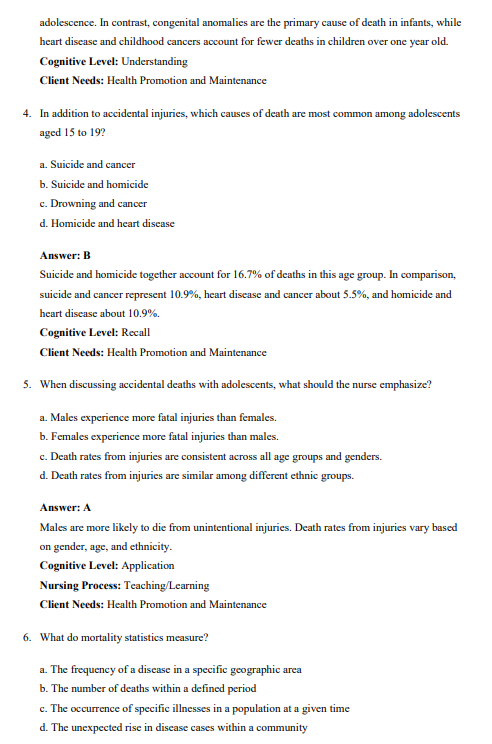
The Test Bank for Wong’s Nursing Care of Infants and Children, 12th Edition (Hockenberry / Duffy / Gibbs) is a meticulously crafted and academically rigorous assessment tool designed to support both nursing students and educators in pediatric nursing courses. Built to align directly with one of the leading pediatric nursing textbooks, this test bank encompasses higher-order questions, clinical reasoning items, and nursing process-based assessments that reflect the complex realities of caring for infants, children, and families.
Comprehensive Pediatric Coverage
The parent textbook uses a family-centred, developmental approach, guiding the learner through each age group, from infancy through adolescence, while integrating body-system organization and evidence-based practice throughout. This test bank mirrors that structure and provides full chapter-by-chapter question sets that span all the major pediatric nursing domains:
-
Foundations of pediatric nursing: growth & development, family health, cultural influences, and health promotion.
-
Assessment and diagnostic reasoning for infants through adolescents.
-
Body-system chapters covering infectious diseases, hematologic/oncologic disorders, cardiovascular, respiratory, neurologic, gastrointestinal, endocrine, genitourinary/renal, musculoskeletal/integumentary, and sensory disorders.
-
Specialized areas such as emergency and trauma care, pain management, atraumatic care, immunization, home & community care, mental health issues in children, and transitional care.
-
Pharmacologic and therapeutic interventions specific to pediatric populations, including dosage calculations, safe medication administration, parent teaching, and developmental-sensitive interventions.
-
Emphasis on family systems, cultural competence, safety, quality improvement, and interprofessional collaboration.
By aligning topics precisely to the textbook’s framework, this test bank ensures that students and faculty are in sync with assigned learning objectives, chapter flow, and the pedagogical emphasis on clinical judgment and family-centred care.
Variety of Question Types & Clinical Reasoning Focus
Recognizing that modern nursing exams (including the NCLEX‑RN and many program tests) emphasize clinical reasoning rather than rote memorization, the test bank incorporates a rich mix of item types such as:
-
Traditional multiple‐choice items covering knowledge and comprehension.
-
Alternate‐format items including select-all‐that‐apply (SATA), ordered-response/prioritization, fill-in-the-blank dosage or lab-value interpretation.
-
Unfolding scenario/case-based questions that require the student to interpret data, determine priority interventions, evaluate outcomes, and reflect on the nursing process. The textbook itself notes inclusion of NGN-style (Next Generation NCLEX) items.
-
Graphs, charts, and lab‐value interpretation items specifically designed for pediatrics (e.g., growth charts, developmental milestones, pediatric vital sign variations).
-
Family-and‐community‐based care scenarios, including home health, school-age issues, adolescent risky behaviours (e-cigarettes/vaping, obesity, mental health), and culturally competent care within diverse family systems.
This diverse format ensures that learners are challenged across all cognitive levels—from recall to synthesis and evaluation—and nurtures clinical judgment, prioritization, and safe decision‐making skills.
Rationales for Deep Learning
Each question in the test bank is accompanied by a detailed rationale that explains:
-
Why the correct answer is the best choice.
-
Why each distractor is incorrect, incomplete, or unsafe in a pediatric context.
-
Underlying pediatric pathophysiology, developmental considerations, family dynamics, and safety implications.
-
Nursing process integration: how assessment informs diagnosis, how interventions are selected/planned, and how outcomes are evaluated.
-
Teaching/communication considerations specific to pediatric care (for children, families, and caregivers).
These rationales transform the resource from a practice question set into a learning tool—promoting reflection, critical thinking, and deeper mastery of pediatric nursing content.
For Educators: Assessment Efficiency & Validity
Nurse educators will find this test bank invaluable for creating valid, reliable, and efficient assessments. Key benefits include:
-
Chapter-organized question sets aligned directly with the 12th Edition textbook, simplifying quiz or exam assembly.
-
Balanced difficulty levels—ranging from foundational knowledge to complex case analysis—allowing for varied assessment strategies (quizzes, mid-terms, finals, online exams).
-
Compatibility with most LMS (Canvas, Blackboard, Moodle) and secure online testing platforms—questions can be randomized, items pulled per topic, and scoring automated.
-
Supports NCLEX/NGN preparation by reflecting real-world item formats, scenario complexity, and pediatric-specific safety concerns (e.g., medication dosages by weight, growth and developmental deviations, parent communication).
-
Helps tracking and remediation: with chapters mapped and difficulty levels indicated, student performance analytics can target weak areas (e.g., adolescent mental health, pediatric pharmacology, pediatric respiratory emergencies).
By utilizing this resource, faculty save time yet preserve high academic standards and align with pediatric nursing competencies and accreditation standards.
For Students: Confidence, Mastery & Pediatric Care Readiness
For nursing students preparing for pediatric courses, clinical rotations, or licensure exams, this test bank serves as a structured study companion:
-
Chapter-specific practice allows targeted review (for infants, toddlers, school‐age, adolescence, system disorders).
-
Realistic, clinical‐judgment style questions build confidence for classroom tests, simulation labs, and pediatric rotations.
-
Rationales help convert mistakes into learning opportunities—why an answer was incorrect and how to apply correct reasoning next time.
-
Pediatric emphasis on family-centred care, cultural competence, and developmental needs helps students become child- and family-focused practitioners, not just adult-centred nurses applying scaled-down adult interventions.
-
Repeated exposure to prioritization, delegation (in a pediatric context), safe medication dosing/administration, and developmental assessment strengthens readiness for real-world pediatric settings and the NCLEX.
Pediatric Safety & Evidence-Based Practice Emphasis
The parent textbook highlights features such as “Nursing Care Guidelines”, “Nursing Care Plan” boxes with expected outcomes and rationales, “Atraumatic Care” boxes, and “Drug Alerts” for safe, age-appropriate medication administration. The test bank reinforces this by including items that focus on:
-
Age/weight‐based medication dosing and IV calculations.
-
Pediatric growth charts, developmental milestone deviations, and age-specific vital signs.
-
Pediatric safety issues such as sedation risk, infection control in children, family dynamics, immunization controversies, and adolescent risk behaviours (vaping, obesity).
-
Emergent/trauma pediatric scenarios (e.g., respiratory distress, head injury, poisoning, sepsis) and appropriate family communication.
-
Cultural competence in child-family care, home/community settings, and inclusive practices in diverse populations.
By embedding safety and evidence‐based pediatric practice into each item, this test bank helps students and instructors emphasise safe, holistic, family-centred pediatric nursing care.
Ideal for Multiple Learning Environments & Uses
This test bank is versatile and suitable for varied instructional formats:
-
Traditional classroom undergraduate pediatric nursing courses (BSN, ADN, LPN‐to‐RN programs).
-
Hybrid or online pediatric nursing modules, where question sets can be delivered electronically.
-
Simulation centres and pediatric lab debriefings—case‐based items can serve as pre‐ or post‐ simulation review.
-
NCLEX/NGN review sessions focusing on the pediatric unit or child health content.
-
Remediation and self‐study for students needing targeted improvement in pediatric content.
Educators can easily reuse question sets across semesters, rotate items, randomize selection, and integrate analytics to monitor student progress in pediatric domains.
Why Choose This Test Bank
The Test Bank for Wong’s Nursing Care of Infants and Children, 12th Edition stands out because it:
-
Aligns precisely with the leading pediatric nursing text, ensuring consistency in content, chapter flow, and learning objectives.
-
Features question formats that reflect modern exam trends—including Next Generation NCLEX (NGN) style items and case-based reasoning.
-
Emphasizes pediatric nursing competencies: developmental stages, family-centred care, safety, pharmacology, community health, and interprofessional collaboration.
-
Provides thorough rationales, promoting deep learning rather than superficial memorization.
-
Saves educators significant time while improving the validity and reliability of their assessments.
-
Prepares students not only for pediatric nursing exams but for clinically competent pediatric practice—supporting safe, effective, compassionate care of infants, children, and their families.
In summary, this test bank transforms pediatric nursing assessment into a structured, competency-based learning experience, merging academic rigor with clinical realism. It equips future nurses with the knowledge, judgment, and family-centred mindset required to excel in child health practice and ensures that pediatric nursing education is both high-yield and deeply meaningful.


Reviews
There are no reviews yet.