
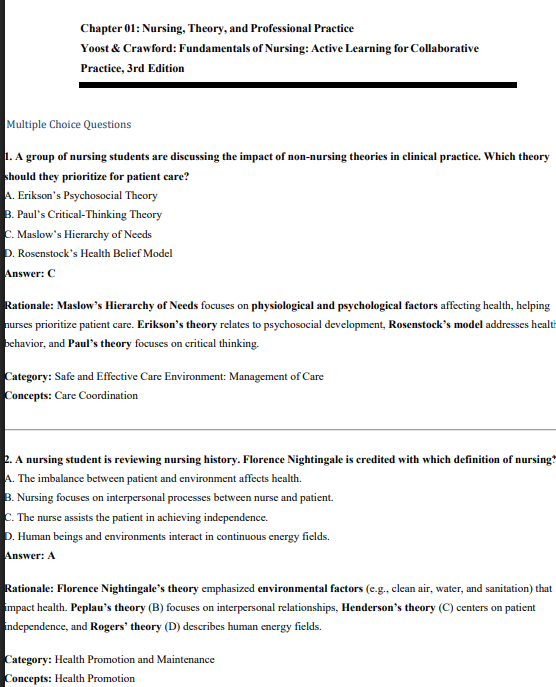

The Test Bank for Fundamentals of Nursing: Active Learning for Collaborative Practice, 3rd Edition by Barbara L. Yoost and Lynne R. Crawford is a comprehensive, evidence-based assessment resource designed to strengthen foundational nursing knowledge, clinical reasoning, and teamwork readiness. Built to align precisely with the textbook’s active learning philosophy, this test bank equips both instructors and nursing students with practical tools for mastering essential concepts that define safe, effective, and collaborative nursing practice.
This expertly curated test bank mirrors the competency-based, student-centered learning approach that Yoost and Crawford champion. It reinforces core nursing knowledge through scenario-based, NCLEX-style questions that reflect current nursing education standards, patient-centered care principles, and interprofessional collaboration models. Whether used for classroom assessments, self-study, or NCLEX preparation, it transforms traditional testing into a dynamic, applied learning experience.
Comprehensive Coverage Across All Fundamentals Topics
Every chapter in Fundamentals of Nursing: Active Learning for Collaborative Practice (3rd Edition) is supported by detailed question sets that test knowledge, comprehension, application, and analysis. This test bank covers the entire scope of fundamental nursing practice, including:
-
Nursing History and Theoretical Foundations – Exploring the evolution of nursing, professional identity, and the integration of caring, ethics, and evidence-based practice.
-
The Nursing Process – Deep assessment of each phase—assessment, diagnosis, planning, implementation, and evaluation—applied to realistic patient situations.
-
Communication and Collaboration – Interprofessional teamwork, SBAR communication, patient advocacy, and culturally competent care scenarios.
-
Health, Wellness, and Illness – Holistic health promotion, illness prevention, patient education, and health disparities.
-
Safety and Infection Control – Standard precautions, asepsis, patient safety, risk management, and fall prevention strategies.
-
Basic Human Needs – Oxygenation, nutrition, mobility, elimination, rest, and comfort care, framed through Maslow’s hierarchy.
-
Documentation and Informatics – Legal documentation standards, EHR integration, HIPAA compliance, and quality improvement reporting.
-
Clinical Skills and Procedures – Step-by-step mastery through skill-based questions on vital signs, hygiene, wound care, positioning, and medication administration.
-
Ethical, Legal, and Professional Standards – Confidentiality, accountability, delegation, advocacy, and scope of practice questions tied to ANA and QSEN standards.
Each topic area features application-based case studies, encouraging learners to think critically about how theoretical knowledge translates into safe, evidence-informed practice.
Active Learning Meets Assessment Excellence
What sets this test bank apart is its integration of active learning methodologies. The question sets are not just designed for memorization—they engage students in problem-solving, reflection, and decision-making aligned with modern collaborative healthcare environments.
Question formats include:
-
Multiple-choice and alternate-format items (select-all-that-apply, fill-in-the-blank, priority ordering)
-
Clinical reasoning case studies with stepwise scenarios
-
Simulation-based questions reflecting lab or clinical settings
-
Communication and teamwork-based problem-solving items
-
Delegation and prioritization tasks involving nursing assistants and interprofessional team members
By using this resource, learners strengthen their ability to apply knowledge to complex, real-world clinical contexts—the ultimate preparation for NCLEX success and confident entry into nursing practice.
Developing Competence Through the Nursing Process Framework
Like the core textbook, this test bank revolves around the nursing process model—the foundation of professional nursing practice. Each question is mapped to one or more of the following components:
-
Assessment: Interpreting data, identifying abnormal findings, and prioritizing patient needs.
-
Diagnosis: Recognizing appropriate NANDA-I nursing diagnoses and defining related factors.
-
Planning: Formulating measurable goals and selecting evidence-based interventions.
-
Implementation: Applying safe and effective skills in both acute and community settings.
-
Evaluation: Judging outcomes, revising plans of care, and maintaining patient-centered focus.
This structured approach ensures that every test item contributes to developing clinical judgment, a crucial skill assessed in both nursing education and professional licensure.
Focus on Collaboration and Communication
The title’s emphasis on Collaborative Practice is reflected throughout the test bank’s design. Many questions present interprofessional care scenarios requiring collaboration with physicians, pharmacists, therapists, and social workers. These items help nursing students build communication confidence, understand role boundaries, and advocate effectively for patients and colleagues.
Scenario examples include:
-
Coordinating care with physical therapy after surgery.
-
Communicating medication discrepancies using SBAR.
-
Addressing ethical conflicts within interdisciplinary teams.
-
Managing workload delegation between RNs and unlicensed assistive personnel.
Each scenario reinforces QSEN competencies—safety, teamwork, quality improvement, informatics, evidence-based practice, and patient-centered care.
For Educators: Streamlined Assessment and Curriculum Alignment
Educators will find this test bank invaluable for creating fair, consistent, and high-quality assessments. Its question bank is organized by chapter, difficulty level, and learning objective, making it simple to align with course outcomes or simulation objectives.
Key benefits for instructors include:
-
Ready-to-use exam questions for quizzes, unit tests, and finals.
-
Secure item banks for online testing or LMS integration (Canvas, Blackboard, Moodle).
-
Immediate rationales for automated grading and feedback.
-
Flexible randomization and performance analytics for tracking student progress.
Each question has been reviewed for accuracy, clarity, and NCLEX relevance, ensuring that exams reflect authentic nursing practice rather than rote recall.
For Students: Confidence, Mastery, and Clinical Readiness
Students benefit immensely from using this test bank as a self-paced study and exam-preparation tool. Each question includes detailed rationales explaining:
-
Why the correct answer is best.
-
Why alternative answers are incorrect or unsafe.
-
How to connect pharmacological, pathophysiological, and psychosocial factors.
-
How to apply the nursing process to clinical decision-making.
By studying with this resource, nursing students will:
-
Build stronger critical-thinking and prioritization skills.
-
Improve exam performance through repeated practice and self-assessment.
-
Develop confidence in communication, documentation, and delegation.
-
Gain a solid understanding of foundational nursing concepts for advanced courses.
High-Quality Question Design and Educational Integrity
Each question in this test bank was crafted by expert nurse educators to reflect current clinical standards, evidence-based guidelines, and professional expectations. The questions meet Bloom’s taxonomy levels from knowledge to evaluation, preparing learners for both academic and professional challenges.
Test content adheres to the latest NCLEX-RN Next Generation Exam (NGN) framework, incorporating unfolding case scenarios that challenge students to recognize cues, analyze findings, prioritize hypotheses, and implement safe interventions.
Ideal for Multiple Learning Environments
This test bank can be seamlessly integrated into:
-
Traditional classroom-based courses
-
Simulation labs and clinical debriefings
-
Online or hybrid learning programs
-
Review sessions, capstone exams, or remediation plans
It’s equally valuable for individual learners preparing for course exams, NCLEX-RN licensure, or refresher programs for returning nurses.
Why Choose This Test Bank
The Test Bank for Fundamentals of Nursing: Active Learning for Collaborative Practice, 3rd Edition is more than a set of questions—it’s a complete learning solution. Its strengths include:
-
Comprehensive alignment with Yoost & Crawford’s textbook chapters.
-
Balanced question difficulty for novice to advanced students.
-
Integration of cultural, ethical, and communication competencies.
-
Strong emphasis on patient safety, critical reasoning, and collaboration.
-
Clearly written, rationale-supported questions designed by nursing experts.
By combining academic precision with clinical realism, this test bank helps transform theory into practice—preparing nurses who are not only competent but compassionate, reflective, and collaborative professionals.


Reviews
There are no reviews yet.