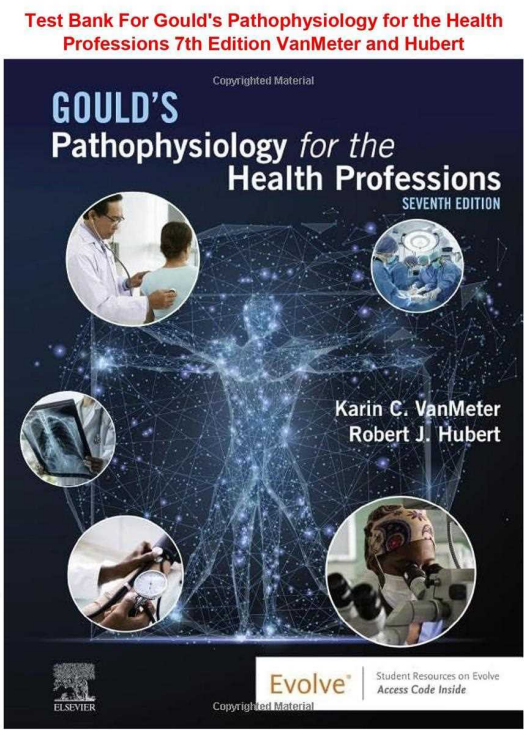

Pathophysiology is one of those classes that trips up a lot of students. It’s not just memorizing body systems anymore. You have to understand what goes wrong, why it goes wrong, and how the body responds. Gould’s Pathophysiology for the Health Professions, 7th Edition by VanMeter and Hubert covers all of that in detail, which is exactly why it’s used across so many nursing and allied health programs.
This test bank was built to match that depth. It’s not a stack of basic recall questions. It’s written to test whether you actually understand disease processes, not just whether you can repeat a definition. You get realistic questions, correct answers, and rationales that explain the reasoning step by step.
If pathophysiology has ever felt overwhelming, this kind of focused practice can make a real difference.
What Is a Test Bank?
A test bank is a large set of practice questions built around a specific textbook. The questions follow the same chapters, concepts, and disease processes covered in the book. Instructors often use test banks like this to help build their own exams, so practicing with one gives you a solid idea of what your exam might actually look like.
It’s not a way to skip studying. It’s a way to study the right material, in the right format.
Why Students Use This Test Bank
Pathophysiology courses move fast. There’s a lot of content, and it builds on itself quickly. If you fall behind on one system, the next one gets harder to follow. This test bank helps you keep up.
Here’s what you get:
- Full coverage of major topics from the 7th edition
- Multiple choice and scenario-based questions
- Complete answer keys
- Rationales that explain the correct and incorrect choices
- Questions written to test understanding, not just memory
Instead of rereading the same pages over and over, you get active practice that shows you exactly where you’re strong and where you need more work.
Topics Covered
This test bank follows the structure of the textbook and covers major disease processes, including:
- Cellular injury and adaptation
- Genetics and congenital disorders
- Inflammation and the immune response
- Infection and infectious disease
- Neoplasia and cancer biology
- Stress and disease
- The cardiovascular system
- The respiratory system
- The renal and urinary system
- The gastrointestinal system
- The endocrine system
- The musculoskeletal system
- The neurologic system
- The reproductive system
Every major body system and disease process from the book is represented, so you can study the same way your course is structured.
Sample Questions from the Test Bank
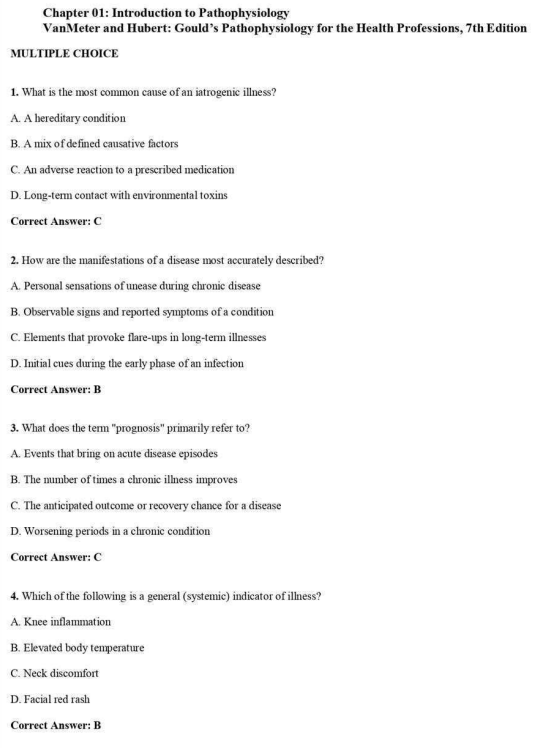
Here are five sample questions so you can see the format and style. Each one includes the correct answer and a rationale.
Question 1
Which of the following best describes the process of inflammation?
A. A localized response that helps protect and repair tissue
B. A permanent state of tissue damage
C. A process that only occurs after infection
D. A response limited to the skin
Correct Answer: A
Rationale: Inflammation is the body’s protective response to injury or harmful stimuli. It helps limit damage and begin the repair process. It’s not permanent, it isn’t limited to infection, and it can happen in any tissue, not just the skin.
Question 2
A patient has chronic hypertension that has gone untreated for years. Which complication is this patient most at risk for?
A. Hypoglycemia
B. Left ventricular hypertrophy
C. Hyperthyroidism
D. Osteoporosis
Correct Answer: B
Rationale: Chronic high blood pressure forces the heart to work harder, which can cause the left ventricle to thicken over time. This is known as left ventricular hypertrophy. Hypoglycemia, hyperthyroidism, and osteoporosis aren’t direct results of long-term hypertension.
Question 3
Which cellular change occurs when a cell is exposed to chronic, non-lethal stress?
A. Necrosis
B. Apoptosis
C. Adaptation, such as hypertrophy or atrophy
D. Immediate cell death
Correct Answer: C
Rationale: Cells that face ongoing stress but aren’t immediately destroyed often adapt to survive. This can look like hypertrophy (getting larger), atrophy (getting smaller), or other structural changes. Necrosis and immediate cell death happen when the injury is too severe for the cell to adapt.
Question 4
A patient with type 1 diabetes has high blood glucose levels and ketones present in the urine. This combination is most consistent with which condition?
A. Hypoglycemia
B. Diabetic ketoacidosis
C. Hyperthyroidism
D. Chronic kidney disease
Correct Answer: B
Rationale: Diabetic ketoacidosis happens when the body doesn’t have enough insulin, so it starts breaking down fat for energy instead. This process produces ketones, which show up in the blood and urine along with high glucose levels. Hypoglycemia is low blood sugar, which doesn’t match this picture at all.
Question 5
Which of the following is a classic sign of impaired gas exchange in the lungs?
A. Increased urine output
B. Cyanosis
C. Joint swelling
D. Skin rash
Correct Answer: B
Rationale: Cyanosis, a bluish tint to the skin or lips, happens when there isn’t enough oxygen in the blood. This is a direct sign of impaired gas exchange in the lungs. Increased urine output, joint swelling, and skin rash relate to other body systems, not gas exchange.
Why This Test Bank Actually Helps You Learn
Pathophysiology isn’t about memorizing a list of symptoms. It’s about understanding the chain of events. Why does one problem lead to another? What’s happening at the cellular level? What’s the body trying to do?
That’s why every rationale in this test bank explains the reasoning, not just the correct letter. When you understand the “why,” you start connecting ideas across systems instead of studying them as separate topics. That’s the kind of understanding pathophysiology exams are built to test.
Who This Test Bank Is For
This resource works well for:
- Students currently using the 7th edition of Gould’s Pathophysiology
- Nursing and allied health students taking a pathophysiology course
- Students preparing for midterms, finals, or licensing exams
- Instructors building quizzes or practice exams
- Study groups reviewing disease processes together
However you learn best, whether through repetition, scenarios, or working through the reasoning yourself, this test bank fits into your study routine.
How to Use This Test Bank Effectively
A few simple habits go a long way:
- Study one body system or chapter at a time.
- Try to answer each question before checking the key.
- Read every rationale, even for the ones you get right.
- Revisit topics that gave you trouble a few days later.
- Use this alongside your textbook and lecture notes, not in place of them.
Steady, spaced-out practice beats cramming the night before every time.
Instant Access, No Waiting
Once you complete your purchase, you get instant access to the full test bank. No shipping, no waiting around. You can start studying right away.
FAQs
Is this test bank the same as the textbook?
No. This is a supplemental study resource meant to be used alongside Gould’s Pathophysiology for the Health Professions, 7th Edition, not in place of it.
Does this cover all the body systems in the book?
Yes. The test bank follows the same chapter structure as the 7th edition, covering all major systems and disease processes.
Are answers and rationales included?
Yes. Every question comes with the correct answer and a clear explanation of the reasoning behind it.
Is this test bank useful for licensing exam prep?
Yes. The questions focus on understanding disease processes and applying that knowledge, which lines up well with how licensing exam questions are written.
Will I get instant access after purchase?
Yes. Access is available right after checkout, with no physical shipping involved.
Can instructors use this too?
Yes. Instructors often use test banks like this one to build quizzes or extra practice material for students.
Is this a one-time purchase?
Yes. You pay once and get full access to the material.
What if I only need help with certain systems or chapters?
The test bank is organized by chapter, so you can go straight to the section you need.
Final Thoughts
Pathophysiology asks you to understand the story behind every disease, not just the name of it. This test bank for Gould’s Pathophysiology for the Health Professions, 7th Edition is built to help you follow that story clearly. Real questions, honest rationales, and practice that builds true understanding.
Study with purpose. Walk into your exam ready to think it through.


Reviews
There are no reviews yet.