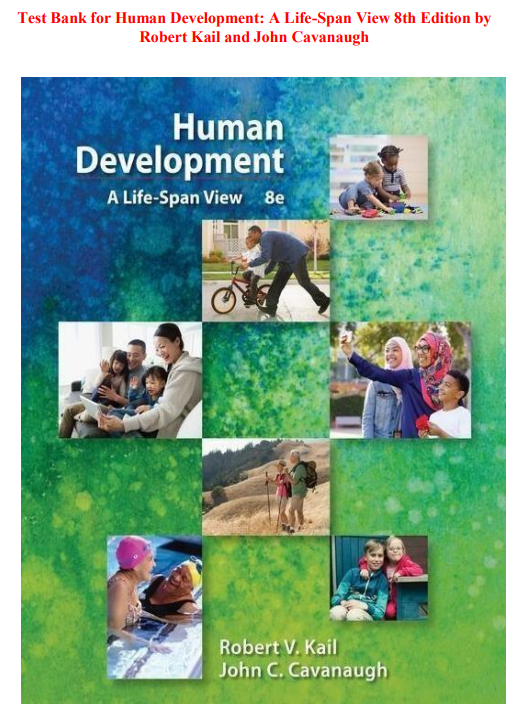
The Test Bank for Human Development: A Life-Span View, 8th Edition by Robert Kail and John Cavanaugh is a comprehensive, conceptually rich, and application-oriented assessment resource tailored for psychology, nursing, and education students exploring the science of human growth and development.
This expertly developed test bank aligns perfectly with the textbook’s life-span perspective, examining development from conception to late adulthood across biological, cognitive, emotional, and social domains. It provides educators and learners with a structured, evidence-based tool for mastering key developmental theories, empirical findings, and applied practice scenarios.
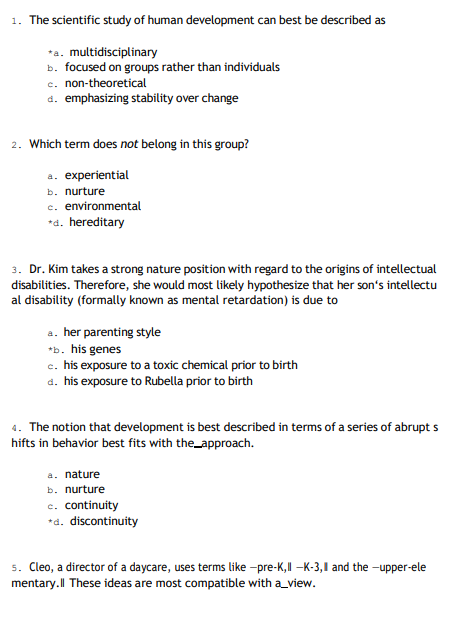
Designed to match the rigor of modern academic standards, this test bank includes NCLEX-style, case-based, and critical-thinking questions that promote not just memorization, but understanding and synthesis. It’s an essential resource for anyone teaching or studying human development, life-span psychology, nursing foundations, or social sciences.
Comprehensive Coverage Across the Life Span
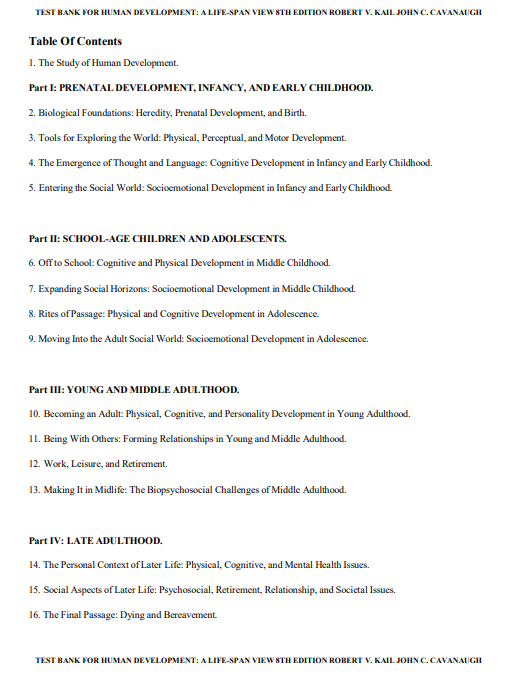
This test bank follows the logical, chronological, and thematic structure of Human Development: A Life-Span View (8th Edition), ensuring consistent alignment with every chapter and learning objective. Major topic areas include:
1. Foundations of Development
-
Key theories and research methods: psychodynamic, behavioral, cognitive, and ecological systems approaches.
-
Lifespan perspective and the balance between nature and nurture.
-
Research ethics and the scientific study of development.
2. Biological Processes and Physical Growth
-
Genetics, heredity, prenatal development, and teratogens.
-
Birth processes, infant reflexes, and early physical growth.
-
Neurological and motor development from infancy through adolescence.
3. Cognitive Development
-
Piaget’s stages, Vygotsky’s sociocultural theory, and information processing models.
-
Language acquisition and literacy.
-
Cognitive changes in adulthood, problem-solving, and wisdom.
4. Socioemotional and Personality Development
-
Attachment theory, temperament, and emotional regulation.
-
Identity formation in adolescence and emerging adulthood.
-
Personality stability and change across the adult years.
5. Psychosocial and Contextual Influences
-
Parenting, family systems, peer relationships, and cultural factors.
-
Work-life balance, midlife transitions, and aging in context.
-
Social policy, ethics, and the role of community support.
6. Aging, Death, and Dying
-
Physical and cognitive aging processes.
-
End-of-life issues, palliative care, grief, and bereavement.
-
The meaning of death across cultures and developmental stages.
This complete life-span coverage ensures that students can connect theoretical models to real-world application and professional practice in healthcare, psychology, or education settings.
Question Types and Learning Levels
To ensure comprehensive assessment and academic integrity, the test bank offers a wide range of question formats designed to measure Bloom’s taxonomy levels—from simple recall to advanced application:
-
Multiple-choice and alternate-format (select-all-that-apply)
-
True/false and matching concept items
-
Fill-in-the-blank and short-answer questions
-
Case-based and scenario-driven application items
-
Critical-thinking and reflection prompts for essay-based evaluation
Each chapter includes a balanced mix of factual, conceptual, and applied questions that allow students to demonstrate understanding of developmental theory, biological principles, and psychosocial adaptation across the lifespan.
Rationales That Reinforce Learning
Every question in this test bank includes detailed rationales explaining:
-
Why the correct option is supported by developmental theory or research.
-
Why the distractor choices are incorrect or incomplete.
-
How the question connects to key textbook concepts (e.g., Erikson’s stages, Piaget’s cognitive development, or Bronfenbrenner’s ecological model).
-
How the principle applies to real-life developmental, clinical, or educational settings.
These rationales make the test bank a powerful learning and remediation tool, helping students strengthen reasoning and connect theoretical frameworks to human experience.
Focus on Theoretical Application and Critical Thinking
Each section of the test bank challenges students to integrate knowledge across multiple dimensions of development. Questions promote:
-
Analysis of theoretical models such as Piaget, Erikson, Bandura, and Bronfenbrenner.
-
Application of research findings to real-world developmental problems (e.g., adolescent risk behavior, cognitive decline, or parenting styles).
-
Evaluation of ethical and cultural considerations in developmental research.
-
Reflection on how context—family, culture, society, and policy—shapes developmental outcomes.
This makes the test bank ideal for both undergraduate and graduate courses where depth of understanding and applied reasoning are emphasized.
For Educators: Efficient, Valid, and Evidence-Based
Instructors benefit from a ready-to-use, classroom-tested assessment system that saves preparation time while maintaining academic rigor.
Key advantages for educators include:
-
Chapter-by-chapter organization aligned with textbook objectives.
-
Clear cognitive-level labeling for balanced test design.
-
Variety of question formats to assess comprehension and higher-order thinking.
-
Prevalidated questions reviewed for clarity, accuracy, and reliability.
-
Compatibility with most learning management systems (Canvas, Blackboard, Moodle).
Educators can easily generate quizzes, unit exams, midterms, or finals—and even integrate these items into hybrid or online teaching environments. The inclusion of rationales and answer keys also supports automated grading and student feedback.
For Students: A Complete Life-Span Learning Tool
For learners, this test bank is not merely a test resource—it’s a comprehensive companion to the textbook that helps students:
-
Understand development from conception to death through realistic examples.
-
Strengthen exam-taking skills with authentic question formats.
-
Reinforce key concepts using guided rationales and cross-references.
-
Build connections between biological, cognitive, and psychosocial growth.
-
Prepare for classroom exams, professional licensing tests, and graduate entrance assessments.
By using this test bank as a study guide, students gain a multidimensional understanding of human growth, preparing them for clinical practice, counseling, or teaching roles that involve interaction with individuals at any stage of life.
Integration of Research and Evidence-Based Practice
The test bank reflects the 8th Edition’s commitment to integrating empirical research and contemporary findings from developmental psychology, neuroscience, and sociology. Topics reflect current global and cultural realities, such as:
-
Cross-cultural perspectives on child-rearing and aging.
-
Modern family structures and their impact on development.
-
Lifelong neuroplasticity and cognitive health.
-
Technology, media, and social development in youth.
-
Mental health and resilience across the lifespan.
This ensures that learners engage with current, relevant, and evidence-informed developmental science.
Diversity, Equity, and Cultural Competence
Aligned with Kail and Cavanaugh’s emphasis on inclusivity, this test bank incorporates items that explore cultural, gender, and socioeconomic diversity in human development. Students are asked to consider:
-
How culture and social policy affect development.
-
How socioeconomic status and access to resources influence outcomes.
-
The importance of culturally competent research and practice.
-
Ethical issues in studying diverse populations.
This focus helps future professionals deliver equitable, inclusive, and sensitive care and education throughout the lifespan.
Next Generation Critical Thinking and Lifelong Learning Skills
Although based on developmental theory, this test bank is written to develop transferable cognitive skills applicable in nursing, education, and psychology programs. Students will practice:
-
Recognizing cues and analyzing information from developmental cases.
-
Applying lifespan knowledge to hypothetical clinical or classroom scenarios.
-
Evaluating interventions or strategies based on developmental evidence.
-
Making informed, ethical, and culturally appropriate decisions.
The structure mirrors the reasoning frameworks found in Next Generation NCLEX-style or higher education assessments—making it ideal for interdisciplinary and applied learning environments.
Ideal for Multiple Disciplines
This test bank is suitable for use across various fields, including:
-
Nursing: Understanding lifespan health promotion, aging, and patient education.
-
Psychology: Application of theories and research methods in developmental science.
-
Education: Supporting child, adolescent, and adult learning development.
-
Social Work and Counseling: Recognizing developmental challenges across family systems.
Its flexibility makes it a valuable instructional tool for undergraduate, graduate, and professional programs.
Why Choose This Test Bank
The Test Bank for Human Development: A Life-Span View, 8th Edition by Robert Kail and John Cavanaugh stands out because it:
-
Aligns perfectly with the textbook’s chronological and conceptual structure.
-
Provides a mix of factual, applied, and critical-thinking questions.
-
Incorporates rationales that promote reflection and mastery.
-
Integrates current developmental research and lifespan perspectives.
-
Reinforces theory, ethics, and cultural awareness.
-
Prepares learners for real-world practice in healthcare, psychology, or education.
By combining academic rigor with accessibility and practical insight, this test bank transforms developmental psychology into an engaging, applicable, and lifelong learning experience.


Reviews
There are no reviews yet.